Setting effective patient goals is one of the most critical yet time-consuming aspects of physiotherapy practice. Traditional goal-setting requires physiotherapists to carefully consider each patient's unique condition, functional limitations, and personal objectives while ensuring goals are SMART: Specific, Measurable, Achievable, Relevant, and Time-bound.
PhysiologicPRISM transforms this process with AI-powered assistance that helps you create comprehensive, patient-centered goals in minutes instead of hours.
The Challenge of Traditional Goal Setting
Physiotherapists face several challenges when setting patient goals:
- Time constraints: Crafting individualized SMART goals for each patient takes valuable clinical time
- ICF framework complexity: Aligning goals with the International Classification of Functioning, Disability and Health (ICF) requires extensive knowledge
- Patient-centered focus: Balancing clinical objectives with patient priorities and preferences
- Documentation burden: Writing detailed, measurable goals that satisfy insurance and regulatory requirements (learn more in our digital documentation best practices guide)
- Consistency: Maintaining high-quality goal setting across all patients and conditions
The clinical reasoning process demands that goals align with your assessment findings and diagnosis, creating an additional layer of complexity.
The PhysiologicPRISM Solution
Structured SMART Goal Framework
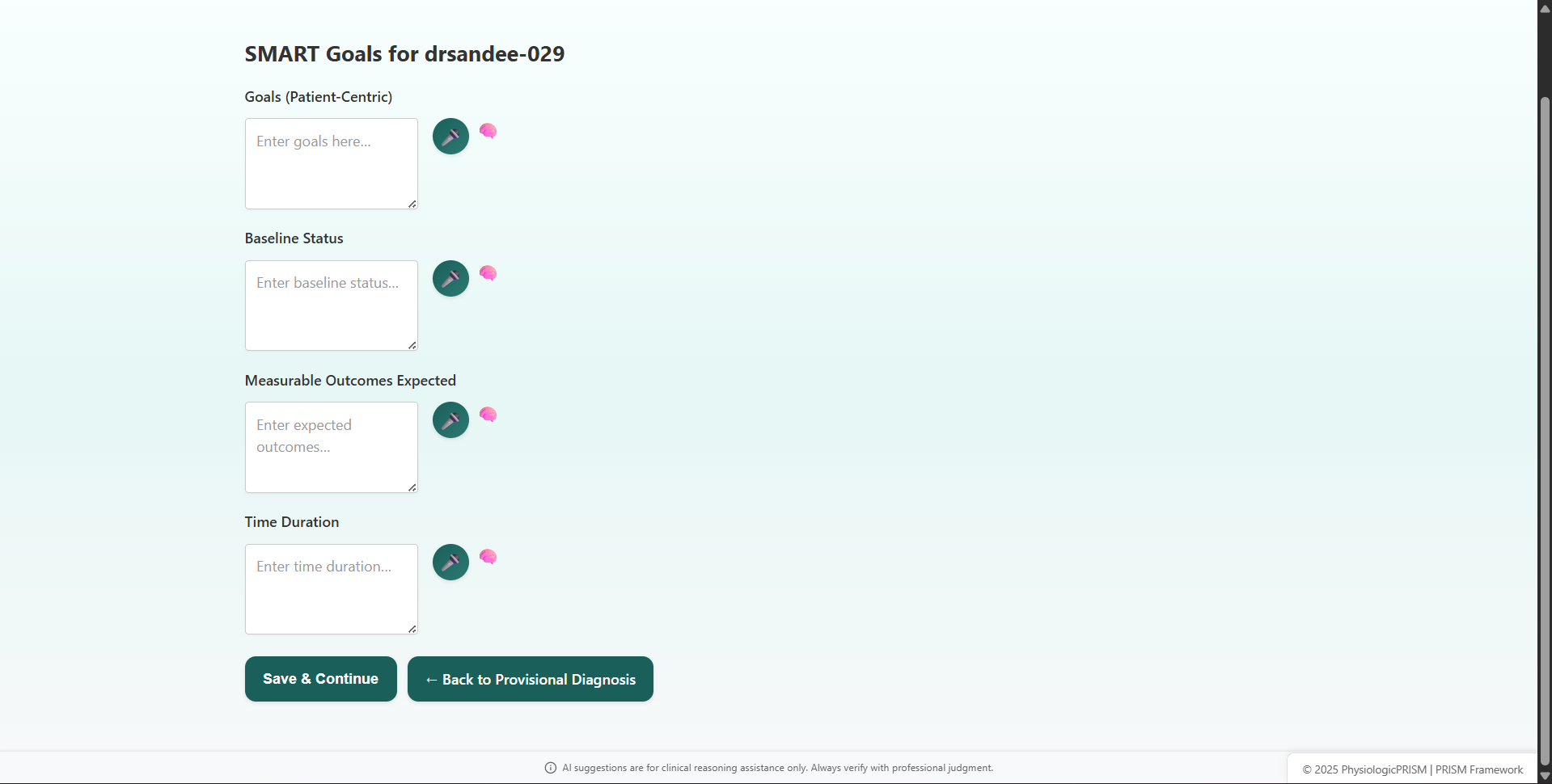
PhysiologicPRISM provides a structured interface with four key components:
1. Goals (Patient-Centric)
Enter the patient's primary goals in their own words, ensuring treatment aligns with what matters most to them.
2. Baseline Status
Document the patient's current functional level to establish a clear starting point for progress measurement. This builds directly on findings from your objective assessment.
3. Measurable Outcomes Expected
Define specific, quantifiable outcomes that can be objectively assessed throughout treatment.
4. Time Duration
Set realistic timeframes for achieving each goal, helping manage patient expectations and treatment planning.
AI-Powered Goal Suggestions
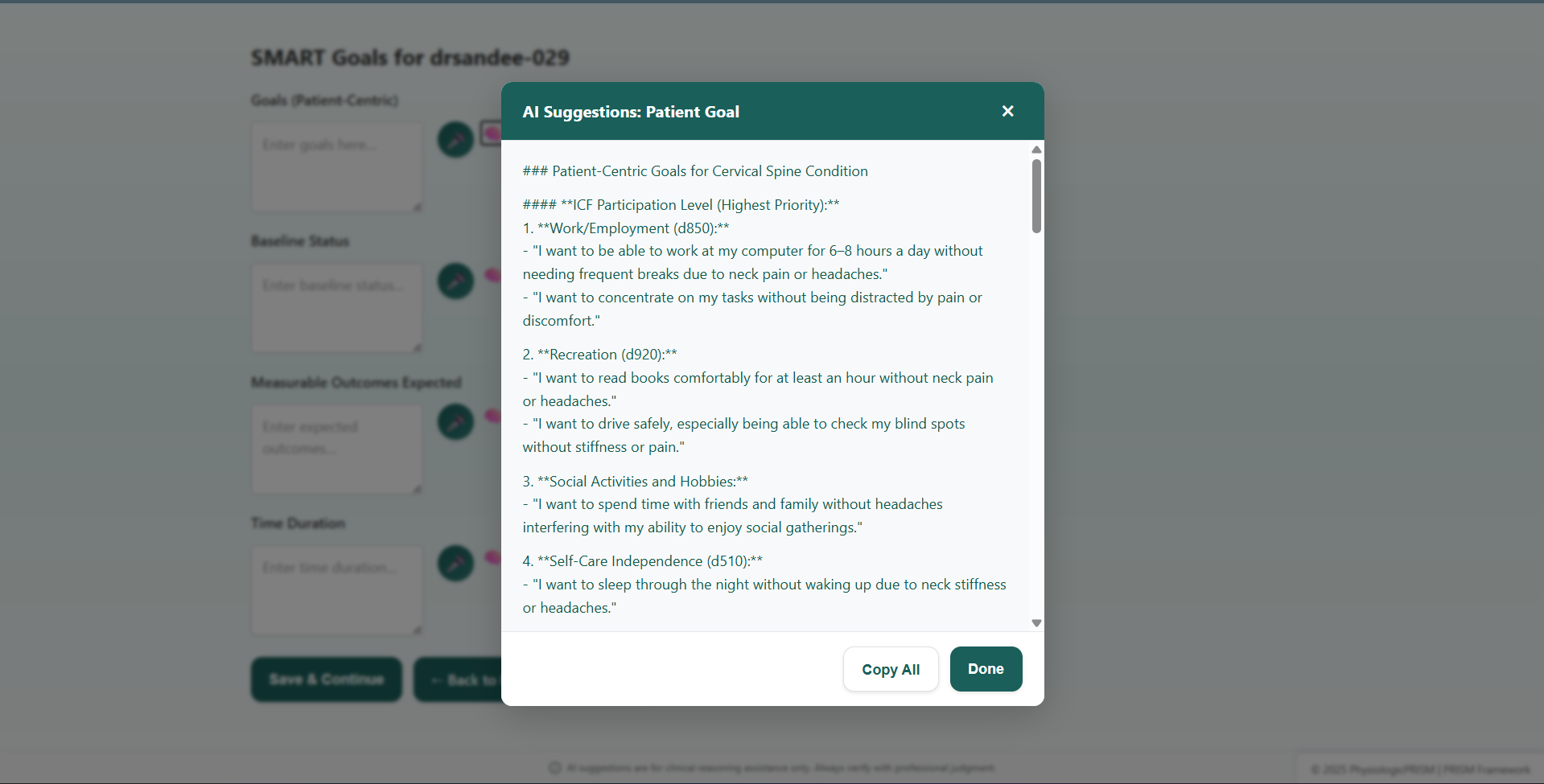
The magic happens when you click the AI assistance button. PhysiologicPRISM's AI analyzes:
- Patient assessment data from comprehensive history taking
- Diagnosis and pathophysiological mechanisms
- Functional limitations documented during objective examination
- Evidence-based outcome measures for the condition
The AI then generates comprehensive goal suggestions organized by ICF Participation Levels:
Work/Employment Goals (d850)
Example for cervical spine condition:
- "I want to be able to work at my computer for 6-8 hours a day without needing frequent breaks due to neck pain or headaches"
- "I want to concentrate on my tasks without being distracted by pain or discomfort"
Recreation Goals (d920)
- "I want to read books comfortably for at least an hour without neck pain or headaches"
- "I want to drive safely, especially being able to check my blind spots without stiffness or pain"
Social Activities and Hobbies
- "I want to spend time with friends and family without headaches interfering with my ability to enjoy social gatherings"
Self-Care Independence (d510)
- "I want to sleep through the night without waking up due to neck stiffness or headaches"
How AI Enhances Your Clinical Practice
1. Evidence-Based Recommendations
The AI draws from current clinical practice guidelines and research to suggest goals that align with best practices for each condition, seamlessly integrating with your evidence-based treatment planning.
2. ICF Framework Integration
All suggestions are automatically organized using the WHO's ICF framework, ensuring comprehensive coverage of:
- Body functions and structures
- Activities and participation
- Environmental factors
- Personal factors
3. Patient-Centered Language
Goals are phrased from the patient's perspective using first-person language ("I want to..."), making them more meaningful and motivating.
4. Specificity and Measurability
Each suggestion includes concrete, measurable criteria that can be tracked throughout treatment, satisfying documentation requirements while improving clinical outcomes.
5. Time Savings
What typically takes 15-20 minutes per patient can now be accomplished in 3-5 minutes, allowing you to focus more time on hands-on treatment.
The Clinical Workflow
1. Complete Patient Assessment: Document subjective examination, objective findings, and provisional diagnosis 2. Navigate to SMART Goals: Access the goal-setting section for your patient 3. Click AI Assistance: Let the AI analyze assessment data and generate suggestions 4. Review and Customize: Select relevant goals and modify them to match patient preferences based on your clinical reasoning 5. Document Baseline: Record current functional status 6. Set Measurable Outcomes: Define specific metrics for progress tracking 7. Establish Timeframes: Set realistic target dates 8. Save and Continue: Move on to treatment planning with clear objectives
How This Can Help Your Practice
PhysiologicPRISM's AI-powered goal setting can:
- Reduce time spent on goal documentation
- Support more personalized, meaningful goals for patient engagement
- Help create clearer, more specific treatment objectives
- Provide comprehensive, well-documented goals for insurance compliance
- Streamline your clinical documentation workflow
Evidence-Based Practice Integration
The AI doesn't just save time—it enhances clinical quality by:
- Ensuring goals align with current evidence for each condition
- Prompting consideration of all relevant ICF participation domains
- Suggesting functional outcome measures appropriate for tracking progress
- Maintaining consistency across your practice
This approach aligns perfectly with the principles outlined in our clinical reasoning framework, where goals serve as the bridge between assessment and intervention.
Beyond Goal Setting: The Complete Treatment Planning Journey
SMART goals are just one component of PhysiologicPRISM's comprehensive clinical reasoning framework. The AI-powered assistance extends through:
- Initial patient history and assessment
- Pathophysiological mechanism analysis
- Clinical reasoning and provisional diagnosis
- Treatment plan development with evidence-based interventions
- Progress tracking and outcome measurement
Each section builds on the previous one, creating a seamless clinical documentation workflow that saves time while improving care quality. Learn more about digital documentation best practices to optimize your entire workflow.
Getting Started with AI-Powered Goal Setting
PhysiologicPRISM makes it easy to integrate AI assistance into your practice:
1. No Learning Curve: Intuitive interface that follows your natural clinical workflow 2. Customizable: Modify AI suggestions to match your clinical reasoning and patient needs 3. Transparent: Always see the reasoning behind AI suggestions 4. Professional Control: You make all clinical decisions; AI provides evidence-based assistance
The Future of Physiotherapy Documentation
AI-powered tools like PhysiologicPRISM represent the future of healthcare documentation—not replacing clinical expertise, but augmenting it. By handling time-consuming documentation tasks, AI allows physiotherapists to focus on what they do best: providing hands-on patient care and applying clinical reasoning.
The result is better outcomes for patients, reduced burnout for clinicians, and more efficient practice operations.
Join the Documentation Revolution
PhysiologicPRISM's AI-powered SMART goal setting is transforming how physiotherapists approach treatment planning. By combining evidence-based practice, ICF framework integration, and intelligent automation, we're helping clinicians provide better care with less administrative burden.
Ready to see how AI can enhance your goal-setting process? Start your free 14-day trial today and experience the difference that intelligent clinical assistance can make in your practice.
Related Resources
Enhance your clinical practice with these comprehensive guides:
- Clinical Reasoning Framework for Physiotherapists - Master the cognitive process behind effective clinical decisions
- Comprehensive History Taking in Physiotherapy - Build a strong foundation for accurate diagnosis
- Objective Assessment Guide for Physiotherapists - Conduct systematic physical examinations
- Evidence-Based Treatment Planning - Create effective interventions based on research and clinical expertise
- Digital Documentation Best Practices - Optimize your entire documentation workflow
PhysiologicPRISM is designed by physiotherapists, for physiotherapists. Our AI assistance is trained on evidence-based clinical guidelines and always keeps you in control of clinical decisions.