Formulating an accurate provisional diagnosis is one of the most critical yet challenging aspects of physiotherapy practice. It requires synthesizing subjective complaints, objective findings, and clinical knowledge while considering differential diagnoses and ruling out serious pathology.
PhysiologicPRISM's AI transforms this complex process into a systematic, evidence-based workflow that enhances diagnostic confidence and ensures comprehensive clinical reasoning.
The Importance of Provisional Diagnosis
A well-formulated provisional diagnosis serves as the foundation for effective treatment:
Treatment Direction
- Guides intervention selection
- Determines treatment intensity and frequency
- Establishes prognosis expectations
- Identifies contraindications
Clinical Communication
- Facilitates referrals to other healthcare providers
- Supports insurance authorization
- Documents clinical reasoning
- Enables continuity of care
Patient Education
- Explains condition in understandable terms
- Sets realistic recovery expectations
- Improves treatment adherence
- Reduces anxiety through clarity
Professional Accountability
- Demonstrates systematic clinical reasoning
- Provides legal protection through documentation
- Meets professional practice standards
- Supports evidence-based practice
Challenges in Diagnosis Formulation
Creating accurate provisional diagnoses is cognitively demanding:
Information Synthesis
- Integrating multiple data sources
- Weighing contradictory findings
- Identifying meaningful patterns
- Filtering irrelevant information
Knowledge Requirements
- Current awareness of diagnostic criteria
- Understanding of pathology presentations
- Familiarity with differential diagnoses
- Recognition of red flags
Time Pressure
- Limited appointment duration
- Need for immediate treatment decisions
- Documentation requirements
- Multiple competing priorities
Uncertainty Management
- Dealing with incomplete information
- Acknowledging diagnostic uncertainty
- Communicating probabilistic thinking
- Avoiding premature closure
The PhysiologicPRISM Solution
Structured Diagnosis Framework
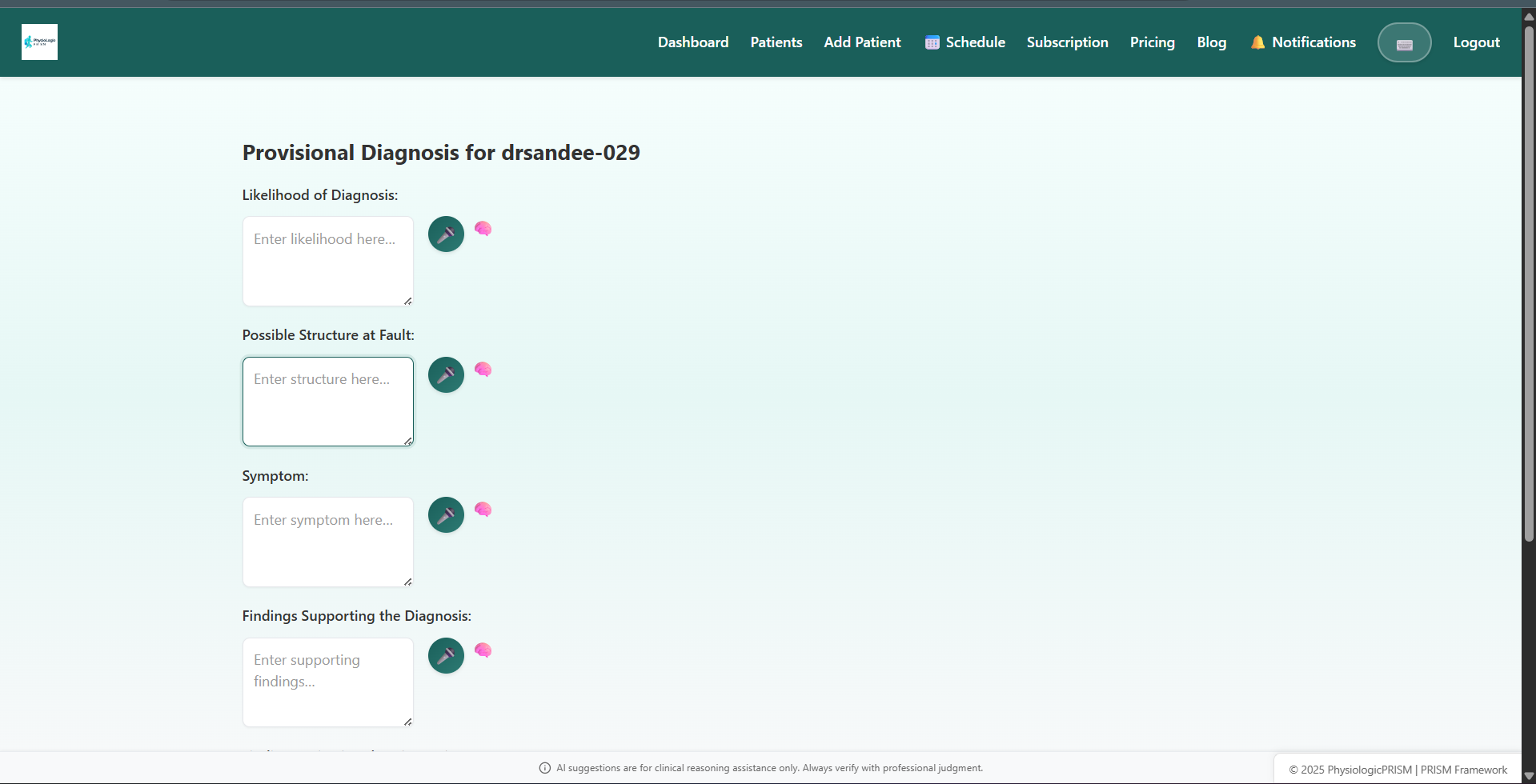
PhysiologicPRISM organizes diagnostic formulation into clear components:
Likelihood of Diagnosis
Express your clinical confidence level based on assessment findings.
Possible Structure at Fault
Identify the primary anatomical structures involved:
- Joints (facet, disc, etc.)
- Muscles and fascia
- Nerves and neural structures
- Ligaments and tendons
- Vascular structures
Symptom Documentation
Record the key presenting symptoms that support your diagnosis.
Findings Supporting the Diagnosis
Document specific assessment findings:
- Subjective complaints
- Objective test results
- Movement patterns
- Pain behavior
- Functional limitations
AI-Powered Diagnostic Assistance
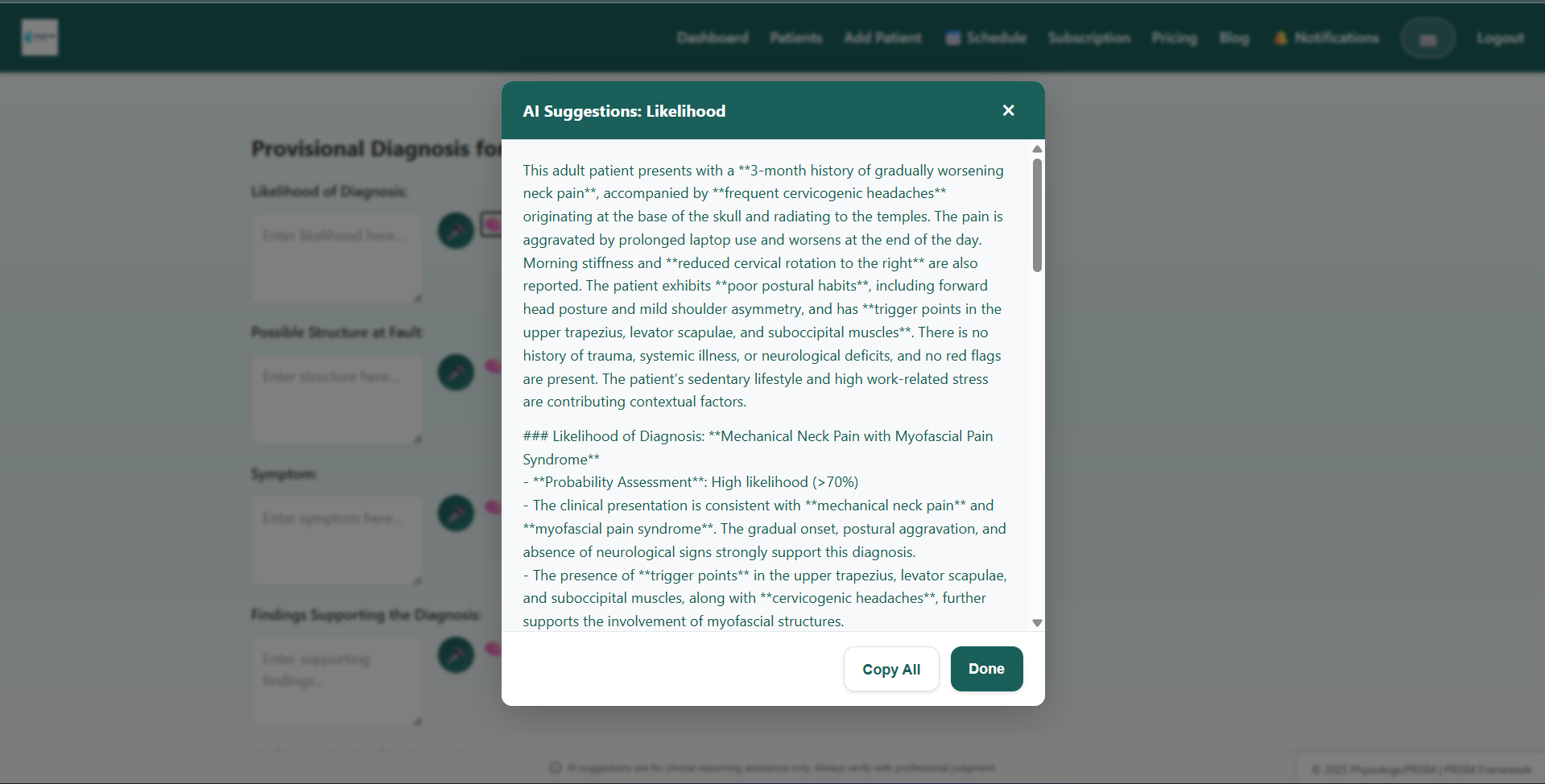
When you activate AI assistance, PhysiologicPRISM analyzes all assessment data and provides:
Comprehensive Clinical Summary
Example for cervical spine condition:
"This adult patient presents with a 3-month history of gradually worsening neck pain, accompanied by frequent cervicogenic headaches originating at the base of the skull and radiating to the temples. The pain is aggravated by prolonged laptop use and worsens at the end of the day. Morning stiffness and reduced cervical rotation to the right are also reported. The patient exhibits poor postural habits, including forward head posture and mild shoulder asymmetry, and has trigger points in the upper trapezius, levator scapulae, and suboccipital muscles. There is no history of trauma, systemic illness, or neurological deficits, and no red flags are present. The patient's sedentary lifestyle and high work-related stress are contributing contextual factors."
Likelihood Assessment with Reasoning
Mechanical Neck Pain with Myofascial Pain Syndrome
Probability Assessment: High likelihood (>70%)
Supporting Evidence:
- The clinical presentation is consistent with mechanical neck pain and myofascial pain syndrome
- The gradual onset, postural aggravation, and absence of neurological signs strongly support this diagnosis
- The presence of trigger points in the upper trapezius, levator scapulae, and suboccipital muscles, along with cervicogenic headaches, further supports the involvement of myofascial structures
Differential Considerations:
The AI systematically considers and rules out alternatives:
Cervical Radiculopathy:
- Less likely due to absence of dermatomal pain patterns
- No neurological signs present
- Pain not following nerve root distribution
Cervical Disc Pathology:
- Possible but less likely without radicular symptoms
- Would expect more severe pain with certain movements
- No history of acute trauma
Risk Stratification
- Red flags systematically screened and documented
- Serious pathology ruled out with reasoning
- Appropriate referral guidance when needed
How AI Enhances Diagnostic Confidence
1. Pattern Recognition Across Thousands of Cases
The AI is trained on extensive clinical databases, helping identify diagnostic patterns you may encounter rarely in practice.
2. Systematic Differential Diagnosis
Never overlook alternative explanations. The AI ensures comprehensive consideration of all reasonable diagnostic possibilities.
3. Evidence-Based Probability Assessment
Diagnostic likelihood is based on published sensitivity/specificity data and clinical prediction rules when available.
4. Clear Clinical Reasoning Documentation
The AI articulates the logical chain from findings to diagnosis, creating professional documentation that satisfies regulatory requirements.
5. Continuous Learning
As you modify AI suggestions based on your expertise, you see different reasoning approaches that enhance your own clinical skills.
Clinical Workflow Integration
Provisional diagnosis synthesizes all previous assessment components:
Data Sources:
- Patient history - Symptom timeline and behavior
- Pathophysiological analysis - Pain mechanism understanding
- Patient perspectives - Functional impact
- Objective examination - Physical findings
- Clinical flags - Red flag screening
Downstream Impact:
- Guides SMART goal setting
- Directs treatment planning
- Informs prognosis discussion
- Establishes outcome measures
How This Can Help Your Practice
PhysiologicPRISM's AI-assisted provisional diagnosis can:
- Streamline the diagnostic formulation process
- Support systematic clinical reasoning
- Help create documentation that meets professional standards
- Provide clear explanations for patient communication
- Support comprehensive differential documentation
The Complete Assessment Journey
Provisional diagnosis represents the culmination of systematic assessment:
1. Patient History - Subjective data gathering 2. Pathophysiological Analysis - Mechanism identification 3. Objective Assessment - Physical examination 4. Provisional Diagnosis - Clinical impression (you are here) 5. SMART Goals - Treatment objectives 6. Treatment Planning - Evidence-based interventions
Each step follows logically from the previous, demonstrating expert clinical reasoning.
Getting Started
Experience the confidence of AI-assisted diagnosis:
1. Complete Your Assessment: Document history and examination findings 2. Click AI Assistance: Generate evidence-based diagnostic reasoning 3. Review and Refine: Apply your clinical expertise to customize 4. Document and Proceed: Move forward with clear diagnostic direction
Start your free 14-day trial and elevate your diagnostic confidence today.
Related Resources
- Clinical Reasoning Framework - Master systematic diagnosis
- Pathophysiological Mechanism Analysis - From symptoms to mechanisms
- Evidence-Based Treatment Planning - Match treatment to diagnosis
- Objective Assessment Guide - Gather diagnostic data
PhysiologicPRISM: Professional-grade clinical reasoning, accessible to every physiotherapist.