Creating comprehensive, evidence-based treatment plans is the culmination of the clinical reasoning process. Yet staying current with the latest research, selecting optimal interventions, and documenting detailed treatment rationales is incredibly time-consuming.
PhysiologicPRISM's AI transforms treatment planning from a 20-minute documentation burden into a 5-minute evidence-based workflow that improves patient outcomes while reducing clinical stress.
The Critical Role of Treatment Planning
Effective treatment plans are essential for optimal patient care:
Patient Outcomes
- Guides systematic intervention delivery
- Ensures evidence-based practice
- Tracks progress toward goals
- Enables timely plan modifications
Clinical Communication
- Facilitates team coordination
- Supports referrals and consultations
- Enables continuity across providers
- Documents professional reasoning
Professional Standards
- Demonstrates evidence-based practice
- Meets regulatory requirements
- Provides legal protection
- Supports insurance reimbursement
Practice Efficiency
- Standardizes common treatments
- Reduces decision fatigue
- Enables delegation to assistants
- Improves appointment productivity
Challenges in Treatment Planning
Creating high-quality treatment plans faces significant obstacles:
Evidence-Based Practice Integration
- Keeping current with latest research
- Accessing clinical practice guidelines
- Interpreting conflicting evidence
- Applying research to individual patients
Time Constraints
- Average treatment plan: 15-20 minutes
- Researching optimal interventions
- Documenting clinical reasoning
- Explaining rationale to patients
Individualization
- Adapting protocols to patient preferences
- Considering comorbidities and contraindications
- Matching interventions to goals
- Adjusting for available resources
Documentation Requirements
- Detailed treatment descriptions
- Clinical reasoning rationale
- Supporting research references
- Goal alignment justification
The PhysiologicPRISM Solution
Structured Treatment Planning Interface
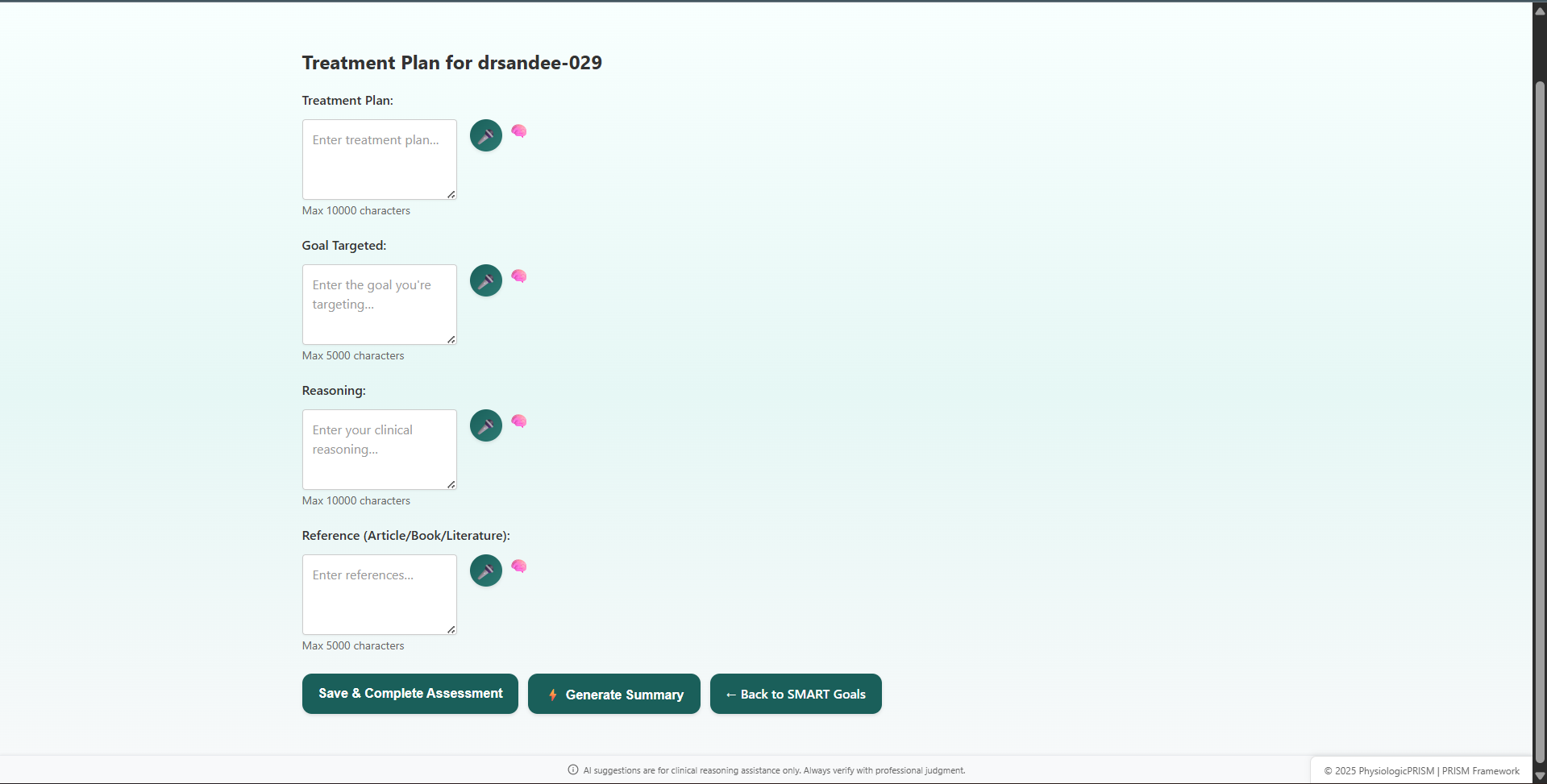
PhysiologicPRISM organizes treatment planning into comprehensive sections:
Treatment Plan
Describe your planned interventions, including:
- Manual therapy techniques
- Exercise prescription
- Electrophysical modalities
- Education and advice
- Home program components
Goal Targeted
Link interventions to specific SMART goals to demonstrate treatment rationale.
Reasoning
Document the clinical logic:
- Why these interventions?
- How do they address the diagnosis?
- What outcomes do you expect?
- What's the evidence base?
Reference (Article/Book/Literature)
Cite supporting evidence from:
- Clinical practice guidelines
- Systematic reviews
- Randomized controlled trials
- Expert recommendations
AI-Generated Evidence-Based Plans
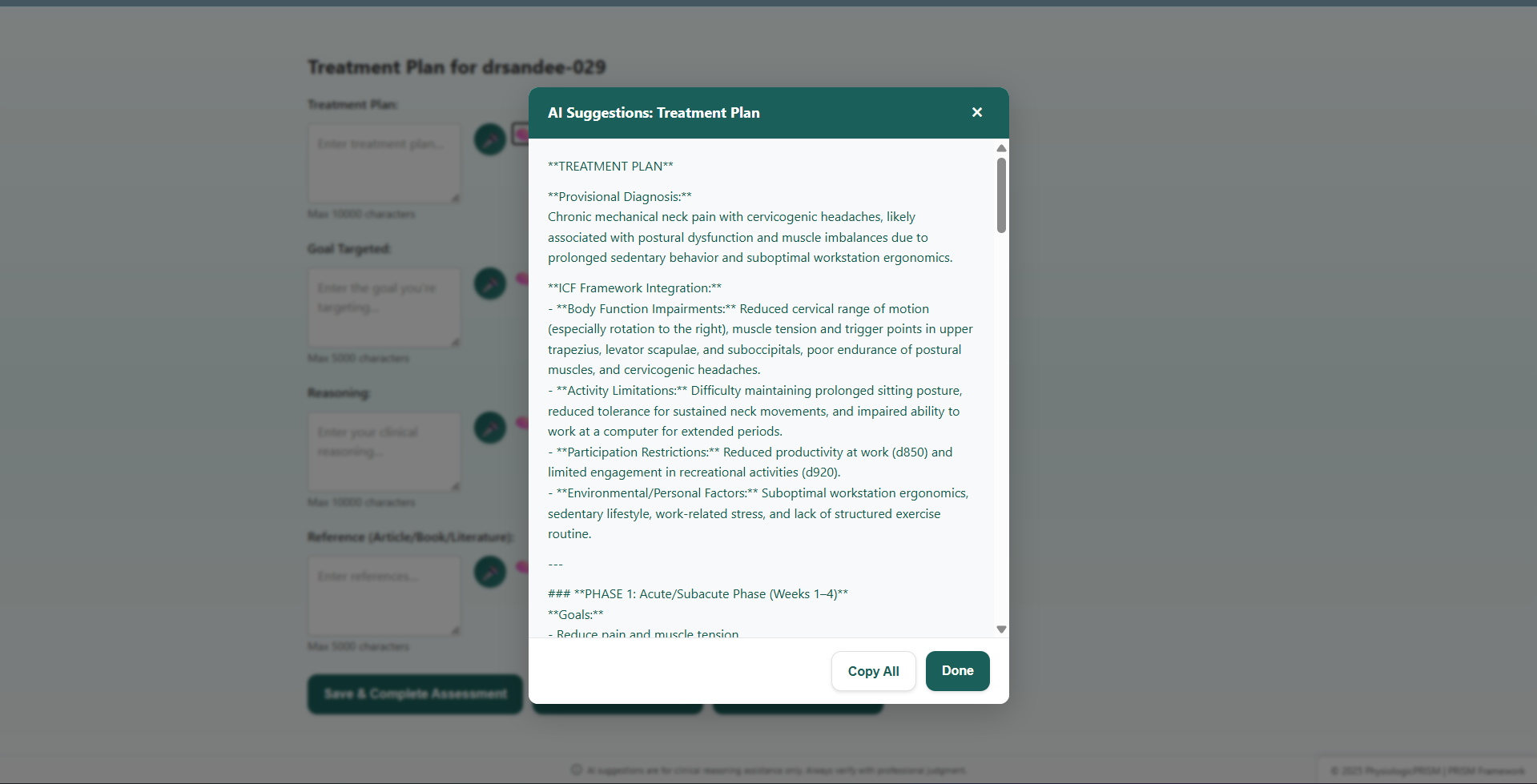
When you activate AI assistance, PhysiologicPRISM analyzes your assessment data and generates:
Comprehensive Treatment Recommendations
The AI creates a complete treatment plan based on:
- Provisional diagnosis
- Pathophysiological mechanisms
- Patient goals and preferences
- Current clinical practice guidelines
- Latest research evidence
Example for Mechanical Neck Pain:
Manual Therapy:
- Cervical spine mobilizations (Maitland Grade III-IV)
- Soft tissue release for upper trapezius, levator scapulae, suboccipital muscles
- Myofascial trigger point therapy
- Thoracic spine manipulation (if indicated)
Exercise Therapy:
- Cervical range of motion exercises
- Deep neck flexor strengthening
- Scapular stabilization exercises
- Postural re-education
- Progressive resistance training for neck and upper back
Modalities:
- Heat therapy for muscle relaxation
- TENS for pain management (if needed)
Education:
- Ergonomic assessment and modification for laptop use
- Pain neuroscience education
- Activity pacing strategies
- Self-management techniques
Goal Alignment
The AI explicitly links interventions to goals:
Targeting: "Work at computer for 6-8 hours without breaks"
- Ergonomic modifications directly address work aggravation
- Postural exercises improve sustained sitting tolerance
- Pain management enables productivity
Clinical Reasoning Documentation
The AI provides detailed rationale:
"This treatment plan addresses mechanical neck pain and myofascial pain syndrome through a multimodal approach. Manual therapy techniques will improve joint mobility and reduce muscle hypertonicity. Deep neck flexor strengthening addresses the muscular imbalance contributing to forward head posture. Ergonomic modifications target the primary aggravating factor (prolonged laptop use). This combination is supported by current clinical practice guidelines for neck pain management."
Evidence-Based References
The AI cites supporting literature:
- "Cervical Overview Group. Manual therapy and exercise for neck pain. Cochrane Database Syst Rev. 2015"
- "Blanpied PR, et al. Neck Pain: Clinical Practice Guidelines. J Orthop Sports Phys Ther. 2017"
- "Gross A, et al. Exercises for mechanical neck disorders. Cochrane Database Syst Rev. 2015"
How AI Enhances Treatment Planning
1. Current Evidence Integration
The AI stays updated with latest research, ensuring your treatment plans reflect current best practices without hours of literature searching.
2. Comprehensive Intervention Coverage
Never overlook beneficial interventions. The AI ensures consideration of all evidence-based options for each diagnosis.
3. Individualized Recommendations
Plans adapt based on:
- Patient-specific goals
- Identified impairments
- Available resources
- Contraindications and precautions
- Patient preferences
4. Professional Documentation
The AI generates detailed clinical reasoning that satisfies insurance, regulatory, and medico-legal requirements.
5. Time Efficiency
Reduce treatment planning time from 20 minutes to 5 minutes while improving quality and comprehensiveness.
Clinical Workflow Integration
Treatment planning synthesizes the entire assessment process:
Data Inputs:
- Patient history - Aggravating factors and functional limitations
- Pathophysiological analysis - Pain mechanisms to address
- Provisional diagnosis - Condition-specific interventions
- SMART goals - Treatment targets
- Objective assessment - Specific impairments
Treatment Delivery:
- Systematic intervention progression
- Outcome measurement
- Plan modification based on response
- Patient education and home program
How This Can Help Your Practice
PhysiologicPRISM's AI-powered treatment planning can:
- Reduce time spent on planning and documentation
- Support selection of evidence-based interventions
- Provide research-supported decision making
- Help create detailed documentation for insurance requirements
- Simplify your clinical workflow
The Complete Clinical Journey
Treatment planning represents the culmination of systematic clinical reasoning:
1. Patient History - Understand the patient 2. Pathophysiological Analysis - Identify mechanisms 3. Provisional Diagnosis - Formulate clinical impression 4. SMART Goals - Set treatment objectives 5. Treatment Planning - Design evidence-based interventions (you are here) 6. Progress Tracking - Measure outcomes and adjust
Each step follows logically, demonstrating expert clinical reasoning throughout.
Getting Started
Experience evidence-based treatment planning:
1. Complete Your Assessment: Document findings and formulate diagnosis 2. Set SMART Goals: Establish clear treatment objectives 3. Click AI Assistance: Generate evidence-based treatment plan 4. Customize and Implement: Refine based on clinical judgment and patient preferences
Start your free 14-day trial and revolutionize your treatment planning today.
Related Resources
- Evidence-Based Practice Guide - Integrate research into practice
- SMART Goal Setting - Foundation for treatment planning
- Clinical Reasoning Framework - Systematic decision-making
- Digital Documentation Best Practices - Optimize your workflow
PhysiologicPRISM: Evidence-based practice, simplified. Your expertise, amplified.